Sreenath
Kyathanahally.
0
Years in AI/ML
0
Publications
Multi-Domain
AI Research
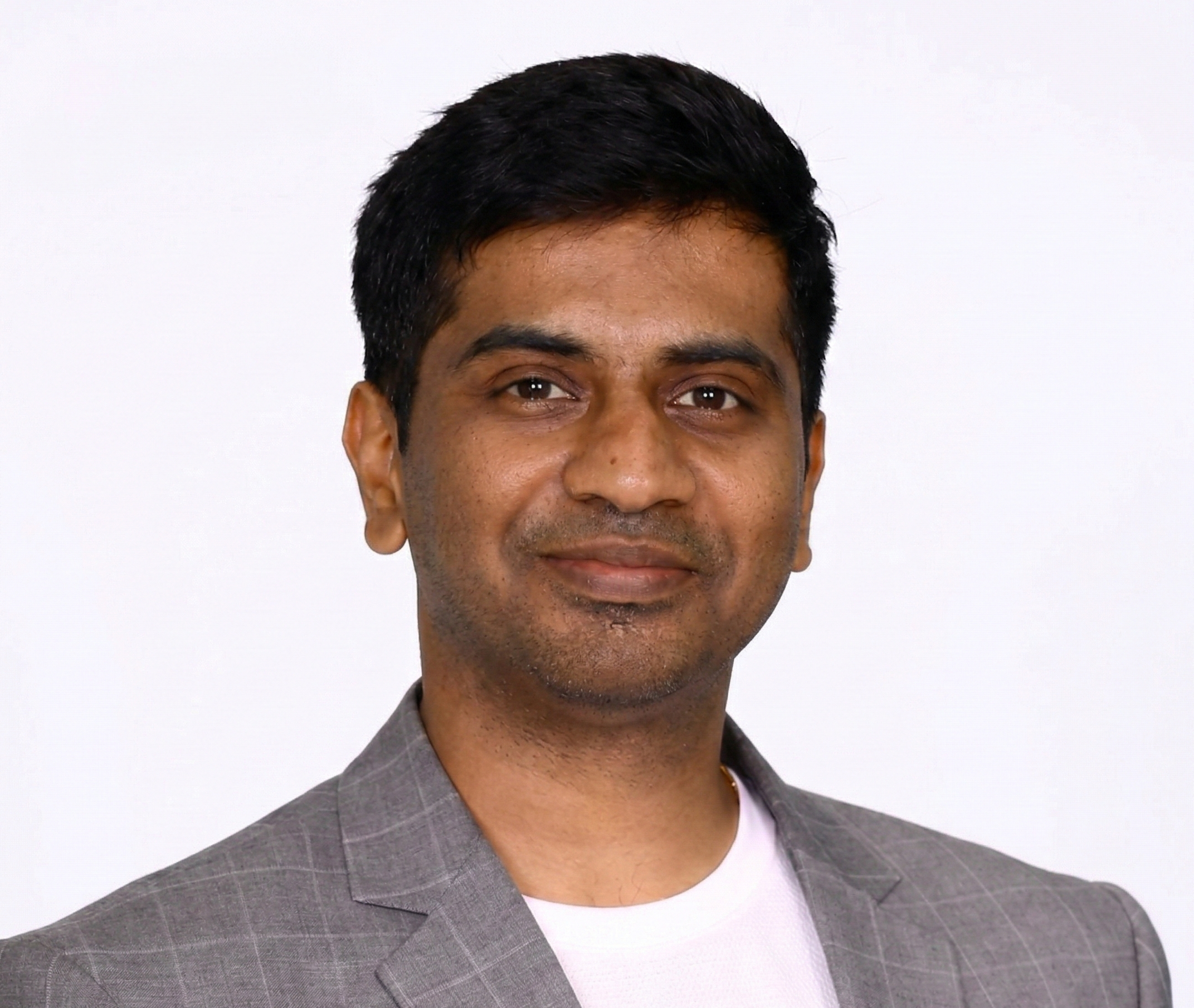
AI Innovation Leader
From PhD research to leading AI innovation at scale
I'm an AI Innovation Leader at IKEA's AI Innovation Lab, where I lead a team of data scientists and researchers building production-grade AI solutions. My work spans generative AI, computer vision, edge AI deployments, and multimodal RAG systems.
With a PhD in Biomedical Engineering from the University of Bern and a Master's in Electrical & Computer Engineering from Auburn University, I combine research experience with practical engineering. My work spans medical imaging, plankton ecology, and adversarial robustness — with publications in leading venues.
I enjoy working across the AI spectrum — from deploying LLMs on edge devices (NVIDIA Jetson) to building agentic AI systems and simulation-grounded inference pipelines.
Deploying LLMs on NVIDIA Jetson with TensorRT optimization
Multimodal RAG, Agentic systems, Stable Diffusion
YOLO, SegFormer, Mask2Former, medical image analysis
15+ publications, CHF 150k grant co-applicant
Experience across the full AI/ML stack
Building next-gen AI systems with LLMs, RAG pipelines, and autonomous agents
Deploying optimized AI models on edge devices for real-time inference
Designing and training neural networks for complex perception tasks
Object detection, segmentation, and visual understanding at scale
End-to-end ML pipelines from experimentation to production
Scalable infrastructure for data-intensive AI workloads
Core languages for AI research and production systems
Application frameworks and data science libraries
AI-powered analysis of clinical imaging modalities
AI systems across Vision Transformers, embodied AI, clinical AI, RAG, adversarial robustness, and zero-shot inference
Simulation-Grounded Inference (SGI) system enabling mobile robots to answer natural-language product queries on retail shelves. Uses photorealistic simulation to evaluate/calibrate a frozen VLM (Qwen2.5-VL-32B) without training. Returns bounding-box coordinates and semantic states.
Investigates how pixel-level differences between imaging systems act as natural adversarial perturbations. Proposes Spectral Adversarial Augmentation (SAA) for training robust classifiers and artifact-aware RAG-grounded VLM prompts for cross-domain generalization.
Addresses dataset shift in plankton classification across imaging systems. Shows ViT-B/16, ResNet-50, and ConvNeXt-Tiny experience 69–73% accuracy drops across domains. Proposes RAG-Grounded VLM classification achieving per-class improvements up to +80%.
Zero-shot functional trait extraction from plankton imagery using a 32B-parameter VLM. Repurposes the VLM as a "digital taxonomist" that extracts structured functional traits without task-specific training. Introduces trait fingerprinting for ecological analysis.
Production-grade plankton classification system using Vision Transformer (DeiT-base) and EfficientNet-B7 ensembles. Classifies 80+ phytoplankton and zooplankton species from microscopy images with 90–94% accuracy. Developed for Eawag/Scripps Camera aquatic monitoring with 515 commits and full MLOps pipeline.
Deep learning system predicting clinical outcomes (walking ability, self-care) for spinal cord injury patients using longitudinal multimodal MRI data. Uses autoencoders for feature extraction from structural and microstructural brain imaging, fusing temporal data for prognostic modeling.
Building AI solutions across research and industry
Co-applicant — CHF 150k competitive research grant (2020–2023)
Top Downloaded Author (2019) & Co-Author (2022)
International Society for Magnetic Resonance in Medicine (2013)
2014, 2015; Educational Stipend (2013–2015)
Research Travel Grant, CHF 4k (2018)
2nd Prize (2016)
Graduate Assistantship & Fellowship (~USD 65k total, 2011–2013)
Peer-reviewed research in top-tier venues spanning AI, medical imaging, and ecology
Open to collaborations, research opportunities, and exciting AI roles
Feel free to reach out for collaborations, research discussions, or opportunities at the cutting edge of AI.